Independent overview by Netops24 — not the official LibreNMS community website.
Enterprise Network Monitoring
LibreNMS review — community-built SNMP monitoring as a zero-licence benchmark
LibreNMS as the network-only do-it-yourself baseline: fast SNMP auto-discovery, what it costs in servers and staff time at 50, 250 and 1,000 devices, and where commercial tools pull ahead.
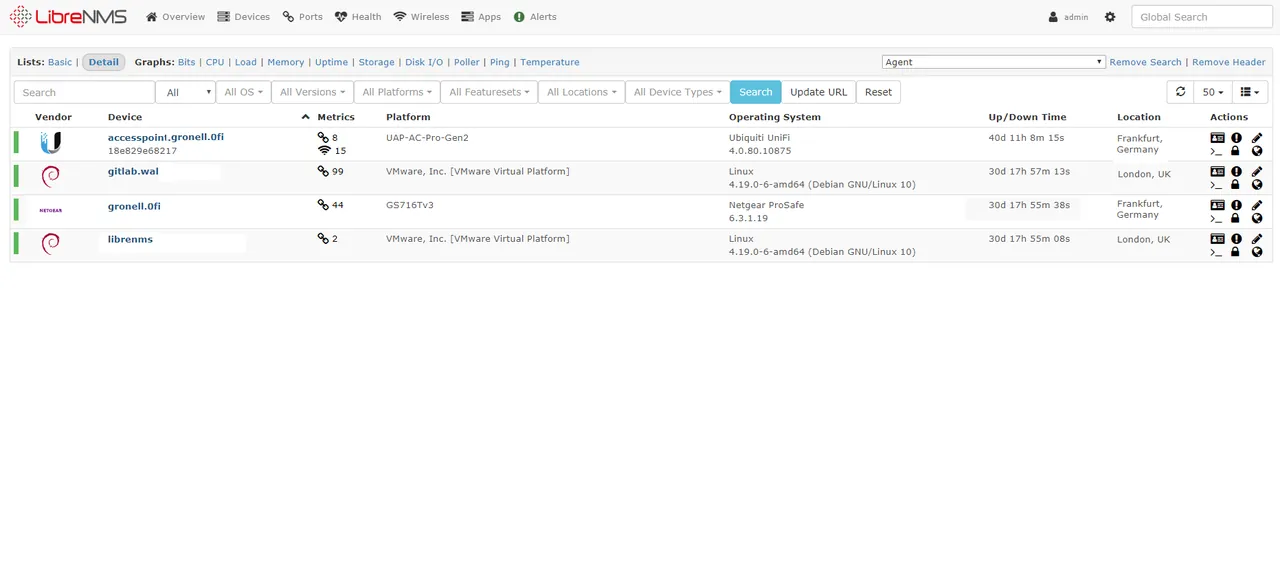
A network engineer with a spare Linux VM and an afternoon can have LibreNMS graphing every switch port in the building before the end of the day. That speed is why it shows up on so many procurement shortlists as the “why are we paying for this?” option. On a typical 90-device campus network, or a 600-device ISP-style estate, that question has a good answer in some cases and a poor one in others — this review sets out which is which.
What it does
LibreNMS is a community-maintained network monitoring system, licensed under GPLv3, written in PHP (Laravel) with Python pollers. It is SNMP-first: give it a subnet and credentials, and it auto-discovers devices, walks CDP, LLDP, FDB and ARP tables to find neighbours, and starts polling interfaces, CPU, memory, temperature, optical levels and vendor-specific sensors. It stores time-series data in RRD files, supports syslog and SNMP traps, draws neighbour maps, and has a rule-based alerting engine with transports for email, Slack, Microsoft Teams, PagerDuty and more. Distributed polling spreads load across multiple poller nodes. It integrates with Oxidized for configuration backup and with Smokeping for latency graphs.
Where it is strong
- Very broad device support. Hundreds of network operating systems are recognised out of the box, from Cisco and Juniper to MikroTik, Ubiquiti and many smaller vendors.
- Fast time to value for network gear. Auto-discovery plus sensible defaults means useful port graphs within hours, with little template work.
- Truly free. No licence, no edition split, no paid feature set.
- Active community. Frequent releases, an active Discord and community forum, and many contributors from ISPs and universities.
- API and integrations. A REST API, Oxidized config backup and Grafana-friendly data make it easy to fit into existing tooling.
Where it falls short, and who should skip it
- Network-only in practice. Servers can be monitored over SNMP, but application, Windows and cloud monitoring are weak compared with Zabbix or Checkmk. Most teams run a second tool for servers.
- No vendor support. There is no company behind it offering an SLA. When something breaks, you rely on the community and your own skills.
- RRD storage limits analytics. RRD files are efficient but coarse over time; long-term, high-resolution trending needs extra work.
- Scaling requires care. Above a few hundred devices, you need rrdcached, a tuned MariaDB and distributed pollers. Poll intervals below five minutes add load quickly.
- Skip it if your auditors require a supported product with a vendor contract, or if servers and applications matter as much as the network.
Who it suits
Network engineers at ISPs, universities, hosting providers and mid-size enterprises who are comfortable with Linux, want deep SNMP visibility across many vendors, and have the time to run it. It is also a sensible stopgap for organisations that need visibility now and will buy a commercial product later.
Licensing and what it costs at 50, 250 and 1,000 devices
LibreNMS is free software under GPLv3; there is no commercial edition and no paid tier. Cost is infrastructure plus staff time. Our model (hours are our estimates):
- ~50 devices: one small Linux VM (2 vCPU, 4 GB RAM) runs everything. Setup takes half a day to a day; ongoing care is an hour or two a month for updates and alert tuning.
- ~250 devices: 4 vCPU, 8 GB RAM, SSD storage, and rrdcached enabled. Setup 2–3 days including alert rules and Oxidized; ongoing half a day a month.
- ~1,000 devices: distributed polling with two or more pollers, a separate database server, and Redis for coordination. Setup a week or more for someone experienced; ongoing 1–2 days a month. Consider paying a consultant for the initial architecture.
Hidden costs: key-person risk (often one engineer built it), the second tool you will likely need for servers, and time spent on custom alert rules. Lock-in is minimal: open source, standard database, and RRD files you can read with standard tools.
Proof of concept instead of a trial
There is no trial because there is nothing to buy. Run a two-week proof of concept: point it at one site, check that every network OS you run is recognised, set up five alert rules that matter, and time the effort. Compare that time with a commercial quote. Our requirements checklist keeps the comparison fair.
How it compares
Zabbix is the other do-it-yourself baseline, stronger on servers and applications and more work for network devices. PRTG and Auvik are the commercial tools most often compared with LibreNMS for smaller network teams; SolarWinds NPM is the usual enterprise comparison. See the enterprise shortlist and pricing models explained.
Getting it safely
Get LibreNMS from librenms.org and its official GitHub organisation, following the documented setup for your Linux distribution, or use the project’s official Docker image. Check that the repository URL is the genuine project, verify commit signatures or image digests where available, and keep the system updated via its built-in update mechanism. Our where to get it page lists what to check.
FAQ
Is LibreNMS suitable for production?
Yes. Many ISPs and universities run it in production at scale. The question is whether you have the in-house skills to support it.
Can LibreNMS back up switch configurations?
Not by itself, but it integrates with Oxidized, which does.
How does LibreNMS differ from Observium?
LibreNMS began as a fork of Observium and is now fully community-developed under GPLv3, with a different feature set and release model.
Does it support SNMPv3?
Yes, including authentication and encryption, which we recommend for any production network. Plan the credential rollout across your switches early; on a large estate it is often the slowest part of the whole project.
Before you start a LibreNMS evaluation
Netops24 does not sell LibreNMS and hosts no files for it. Start your evaluation on LibreNMS community’s own site, check the address bar shows librenms.org, and read our where-to-get checklistfor what a trial sign-up normally asks for. Our verdict label is explained on the methodology page.